Wargaming the Exploration and Colonisation of Tropical Africa by European powers from 1850 until 1918.


Saturday, 26 February 2011

Zambezi Campaign 9: Sikh Unit

The pack of eight Foundry Sikhs

Here is the pack of Foundry Sikhs which I finished today.  I was delayed in finishing them as I found out that I had painted their turbans and belts the wrong colour so had to correct that this week. 


The force of six Sikhs needed for the scenario


In Nyasaland in 1891 Sikhs were recruited from the Indian Army along with Muslim cavalrymen and Zanzibaris under Sikh NCOs.  In 1893 another 200 Sikhs were recruited and were very active in the anti-slaver wars until 1895.  By 1898 when the Ngoni rebellion was being dealt with the only Sikhs remaining were the NCOs commanding African troops.  Still, there is a good solid historical background which makes their appearance in these scenarios quite justified.

Sikh NCO Nyasaland


I must say I thought that Mark Copplestone had severely exaggerated the appearance of the Sikhs' turbans (more than the usual 28mm exaggeration, anyway) until I found a photograph of a Sikh NCO from Nyasaland.  These were big turbans!


Sikh of the Indian Contingent in Nyasaland (c. 1893)

Their original uniform was very colourful, after the Zouave fashion, with a black turban, black jacket with yellow cuffs and piping, yellow trousers and white shirt and gaiters.  The uniform was designed by Johnson, the first commissioner for the British Central African Protectorate, and the three predominant colours of black, yellow and white were supposed to represent the three races involved in the force ( African, Asian and European).  By the time of our scenario the Sikhs were wearing standard khaki.


The total Sikh's painted


These were pretty good to paint although, unusually for Copplestone, there were a few vague bits of metal, particularly around the water bottle and some of the straps.

I now only have two more elements to paint for the British: the 14 irregular askaris, which I have now based and undercoated and the four  baggage elements which will comprise eight porters (as I think four look a bit silly).

I haven't painted any figures other than for this project this year and in two months have done 52 figures, which is my best yearly start for three years.

Tuesday, 8 February 2011

African library 1: Sir Samuel Baker


An elephant hunt from Sir Samuel Baker's The Albert Nyanza


One of the things that keeps me focussed on a wargaming project is reading books about the subject.  Of course, the problem for me is that reading a book on a particular subject often then makes me want to start a wargaming project!  So I am going to write the occasional post about my Darkest Africa library, which is not that extensive, but provides enough source material to keep me occupied with potential projects.

I will start with Sir Samuel and Florence Baker as the two were, in every sense, inseperable.   I wrote about them in the blog previously so have nothing to add here about their lives.  I have three books relating to them.


The first one I read is Pat Shipman's To the Heart of the Nile (2004).  This is a wonderful introduction to the story of the Bakers and gives Florence a much greater part than is usual in accounts of their activities.  It is, however,  rather peculiarly full of invented dialogue between them which doesn't damage the narrative drive of the book but does impact on its credibility.  Still, very enjoyable and it contains a good number of (small) illustrations.


Lovers on the Nile (1980) by Richard Hall tells the same tale but in a more economical and spare manner.  I can't help feeling that the titles of the two books should be swapped to better reflect their contents!  It has eight pages of illustrations in the centre.


My third book is Baker's The Albert Nyanza Great Basin of the Nile and Exploration of the Nile sources (1866).  Based on his diaries it is a fascinating insight into the experience of a Victorian explorer cut off from all but his own (and his redoubtable wife's) devices.  My copy is the 1913 edition and, somehow, these older books add to the sense of adventure when reading them!  This book also contains many illustrations of engravings based on Baker's own sketches.

Zambezi Campaign 8: a few oddments.


Whilst doing the Naval Brigade I also painted a few other characters.  Firstly, and most importantly, I painted the British standard bearer because the scenario forces require one.  In fact, by this time,  British forces didn't carry standards in battle anymore so we have an unofficial standard bearer carrying the Union flag.


After I finished the British askaris I found, annoyingly, one more which I had missed so finished him up too.  I think I will use one of these uniformed askaris to command the group of 14 levy askaris required.  I found that I already had enough figures for this unit so they are now based and ready for undercoating once the Sikhs are done.


Finally, I bought some Darkest Africa odds and ends off eBay, mainly to get some more bearers but also included was this female villager.  She is an excellent piece of Copplestone characterisation and I thought that she would make a suitably combative wife for the chief of the Wasimba village which gets attacked by the Arabs in one of the scenarios.  She is resplendent in red tradecloth skirt and bronze bangles.

Along with the Sikhs I am also going to start work on the British baggage elements.  Some of these will be newly painted and some will be old, repainted figures.

Zambezi Campaign 7: Naval Brigade


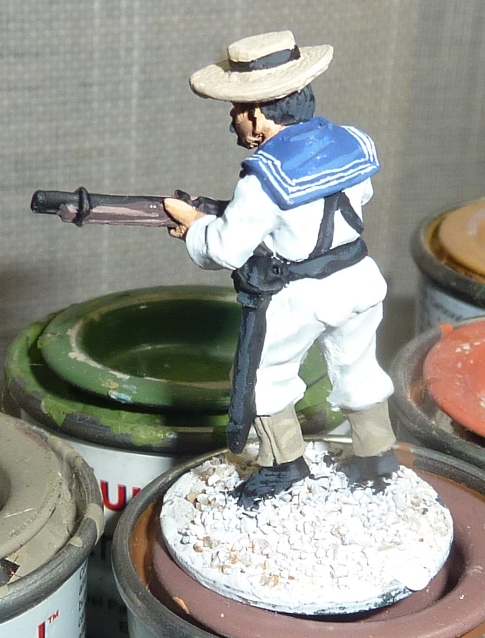
I have, at last, finished the Naval Brigade for the Zambezi campaign.  In the scenario they are trying to repair their steamboat.  If they do, they reinforce the main infantry force with two small units of six men as well as more food and ammunition.  I have gone for the all white tropical uniforms with sennett hats.  I am contemplating adding one or two annoying civilians to the steamer's passenger list; probably a female reporter, loosely based on the faintly unbelievable character in the John Wilcox novels.  This is merely so I have an excuse to paint a few more character figures, which is helping me not get bored with the unit painting.


Here is the first Naval Brigade unit commanded by a junior lieutenant.  I wasn't sure about painting black edging around the brim of the seamen's hats.  Some pictures I have seen have them and some don't.  In the end I went for not, based on this, as it is an actual photograph rather than an illustration or a re-enactors recreation.


Below is the second unit of six, commanded by a midshipman.  These Copplestone Castings figures are on the large side but as the proportions are the same as his Foundry figures it is not too noticeable.


The scenario doesn't list one but I thought they needed a commanding officer so have painted up Lieut. Troutbridge here. 


He'll add a few points to the Naval side but a few more troops on the Arab side will balance him out.  Finally, I felt that the gunboat would need a captain so here is Capt Rufus Copperfield.  Sidelined to the rusting heap that is the paddleboat Queen Charlotte, because of an unfortunate incident with an unmarried lady in a railway carriage, he is determined to take his revenge on the diabolical Arab slavers, or The Press, as he prefers to call them.  The rumours that a reporter is due to join his voyage upriver does not fill him with pleasure.


Next up are the Sikhs!

Monday, 24 January 2011

Zambezi Campaign 6: Rev MacSporran


Apart from the larger units, the Gary Chalk scenarios require a number of characters as well.  Although I am proceeding well on the Naval Brigade I have to go to Turkey this week so won't get them finished until (hopefully) this weekend.  They are nearly done but the collars of the sailors require, in total, 90 very fine white lines and this is taking almost as long as the rest of the painting!


So, in the meantime, I painted the Scottish reverend I need for one of the scenarios.  Chalk calls him Rev McKenzie but I have named mine Angus MacSporran after someone I met once. You wouldn't have thought that such a name could possibly be real but it certainly is!


I think I might give him a wife, as there is a perfect Foundry figure in one of my boxes.  He is a non-combatant so it doesn't matter, from a scenario point of view, if there are two figures rather than one.


The next figures I have based and undercoated are the Sikhs.  You only need six but I got eight in my Foundry pack so will paint them all anyway.

I have also started work on the British standard bearer and I found an extra unpainted British askari who will be the leader of the unit of 14 local levy askaris.

Sunday, 16 January 2011

Zambezi Campaign 5: Starting the Naval Brigade

The Naval Brigade under way as of this morning.  I have shaded their uniforms and blocked in the coloured collars, gaiters and rifles today.


I managed to do a few hours on my next unit, the Royal Baval Brigade, today.  Amazingly I have managed to stay focussed on this project for several weeks now!  I think the good thing is that the units are quite small and there is enough variety in troop types that if I get bored with one I can do a bit on another.


A Royal Navy silor in tropical uniform.  White tops were more common in Southern Africa


Naval troops were fairly active in Africa (outside of the main areas of action such as Egypt and the Sudan) towards the end of the nineteenth century particularly against the Somalis and Swahili towns in the eighteen nineties.  Troops involved were a mixture of armed ratings and Royal Marines but for this force I will be just using the sailors. 


A turn of the century Naval sennet hat.  The black trim seems not to have been worn in the earlier period.


As I start to paint the sailors I realise that these figures come from Copplestone Castings "big" period when some of his figures got really huge (something to do with the prescription for his glasses, apparently).  I'm usually bothered about this sort of thing but as they are in the same style, naturally, as the Foundry figures it doesn't look so bad and, after all, the Arabs and natives probably weren't so well fed!


Royal Navy sailors in Egypt in 1882


Uniforms of sailors at this time were blue but those in tropical climes also wore white with blue collars and black neckerchiefs.  I have already painted a Naval Brigade unit with the blue uniforms and round hats for the Sudan so wanted a different look for these. I am contemplating painting some of the officers with blue coats just for a bit of variety.


My Sudan Naval Brigade figures


Leather equipment was black, with khaki gaiters.  Sailors did wear the round hat in Africa but the broad brimmed sennet hat, known as a benjy, was far more common and was, looking at contemporary illustrations, worn with the brim turned up, exactly as Mr Copplestone has sculpted them.


Royal Navy sailors having a spot of bother in Africa in 1894


He has included the distinctive sword bayonets in their scabbards but I would probably have preferred the figures to have fixed bayonets.  Also, for some strange reason, he does not include water bottles; something of a neccessity in Africa, I would have thought.


Both types of uniforms as demonstrated on some Britains figures


I have quite a busy week this week but hope to get them finished next weekend.  Then its on to the Sikhs, who arrived from Foundry this week and who I have just filed and based.

Thursday, 6 January 2011

Zambezi Campaign 4: Regular Askaris


1st Unit of regular Askaris


I have now finished the first two British units for what I am now calling my Zambezi Campaign.  These are the two units of 8 Regular Askaris.  I have given each one a Sikh NCO. 


2nd unit of askaris


I actually painted 26 askaris so have twelve in reserve if I ever decide to increase the forces.  To start with, though, I am going to stick to Gary Chalk's initial forces.


The complete batch


To complete the British expeditionary force I need a unit of irregular askaris, a standard bearer and the officer (actually, I am going to use two officers).

Next up and ready for undercoating, is the Naval Brigade.  I hope to get going on them this weekend.

Wednesday, 29 December 2010

Zambezi Campaign 3: Identifying some more figures

The British Askaris on the workbench


Progress is slow but steady on the British askaris.  The standard of my painting from eight or nine years ago is pretty woeful as it was before I realised that I needed glasses!  As a result, I am re-painting most parts of them.  The only thing I will leave is the khaki uniforms but will add some lowlights and highlights to sharpen them up a bit.  I have also started the six figures I bought on eBay recently.  This will give me 26 Askaris so with two Sikh NCOs that is 28 figures.  The scenario only calls for 16 figures so that will give me ten spare.  Either I will up the numbers of the figures proportionately for everyone or, more likely, I will devise a scenario requiring extra re-inforcements.

The total British forces required under the scenario are as follows:

Expeditionary force

Unit of 8 regular askaris
Unit of 6 Sikhs
Unit of 14 local levies
1 standard bearer
1 Officer

Relief Force

Unit of 6 sailors
Unit of 6 sailors
One gunboat

However I am going to modify them somewhat.

Firstly, I will add a second officer to the expeditionary force.  The scenario allows for the substitution of a second in command if the leading officer is killed.  I think that this is a bit silly if he is not with the initial force in the first place. It adds 28 points to the British force but that isn't many to add to the others. 


The Royal Navy contingent filed and based


I have found that I have enough figures for the naval force and will add an officer to that.  I will also paint a figure for the Gunboat captain.  I will need a gun and crew for the gunboat as my paddle boat is unarmed.  Foundry make a set of Naval gunners and a fieled gun in their Zulu War range and although they will be much smaller than the rather large Copplestone sailors the look is similar so I will probably go with those.


Foundry Naval gunners

Thursday, 23 December 2010

Zambezi Campaign 2: Starting work on the British Askaris

In this post I am going to look at the first two units I need to complete for my River Campaign: the British regular askaris. 


I have a number of Foundry British askaris which I had started years ago and I also picked up another half dozen in a job lot of askaris I bought on eBay a few months ago. I bought these mainly because they had a fair number of the now out of production Copplestone Zanzibaris in amongst them so the extra British askaris were a bit of a bonus.  I decided to get them out and see how they would fit into the Gary Chalk scenarios.  Although I said at the start that I wasn't bothered about historical accuracy for this project I had to do some research!  I dug out my copy of the excellent Foundry book Colonial Armies Africa 1850 to 1918 by Peter Abbott.  This is now out of print and is going on Amazon marketplace for a staggering £90!


Foundry British Askaris from their old website (now you only get six figures in a pack, of course)


The Foundry British Askaris don't actually look exactly like any of the British native troops of the time although they look similar to some.  When they first came out the Foundry website had an article that said that "These askaris are based on the troops raised by the British around Lake Nyasa to fight the Arab slavers."  This gives us a good clue as to where to start as regards their uniform details.  A little history also illuminated the possible location of the action.


Scottish missionary in Nyasaland


As Scottish missionaries (most famously Dr David Livingstone) moved into Nyasaland in the mid 1870s European traders followed and they all wanted a stop to the activities of slavers. Fighting started in 1885 and by 1888 had developed into a major war.  In 1891 a force of Sikhs backed by Zanzibaris under Sikh NCOs was formed.  It wasn't until 1893 (when Nyasaland was re-named as the British Central Africa protectorate) that the first Africans were added to the forces and supported by a Royal Navy detachment.  The slaver war had been won by 1895.  In 1896 the protectorate of Nyasaland's forces had been reorganised into the Central Africa Rifles and they saw service against the Ngoni in 1898. 


Portugese Slavers


Meanwhile, up in Northern Rhodesia  (which wasn't called that yet) in 1889, Arab and Portuguese slavers were very active, preying on the local tribes.  In October 1889 Cecil Rhodes obatined a Royal Charter for the British South Africa Company to maintain a police force.  Over the next decade white "collectors" backed by small units of native police drove out the slavers; on two occasions backed by troops from Nyasaland.  Some of the local tribes were anxious for British protection as they were worried about raids from the Matabele in the south.  Several expeditions were launched along both banks of the Zambezi in 1898 to deal with cattle raiding and what have you.


Southern Africa at the end of the nineteenth century


So, we can see the inspiration for Gary Chalk's British expedition up the river.  It is a mixture of historical activity in Nyasaland (now Malawi) and Northern Rhodesia (now Zambia). Expeditions were mounted up the Zambezi. We have uniformed African troops and Sikhs backed by the Royal Navy acting against Arab slavers.  The period is slightly later than I had imagined: 1889-1898.  By this time there wasn't much of Africa that was unexplored so the opportunity for lost civilisations is limited!  I'll probably still put one in though!

So, my campaign will be fought on a semi-historical Zambezi in around 1896 but we will fling in some of the tribes from further East in Nyasaland (principally the Ngoni who we have already started to paint).  The Ngoni would make an ideal substitute for the annoying pygmies in the original scenario.  This all is particularly satisfying as it was Northern Rhodesia (Zambia) I visited last month.  If I go again next month (which I may have to) then I hope to actually get a proper view of the Zambezi itself!


Central African Rifles c. 1900

So, if we look at the historical uniform of the Central African Rifles from Nyasaland we can see that they have a khaki smock, khaki breeches and putees with brown sandals and a black tasseled fez.  The Foundry figures don't have putees but otherwise they are pretty close.  In the earlier period the British levies didn't have uniforms at all and the later levies had a simple blue uniform with a red fez.  One thing that is clear is that the later African troops, by the time they became known as the Central African Rifles, had, unusually, black fezzes rather than the usual red.  This is so that their headgear matched the black turbans of the Sikh troops.  The waist belt and ammunition pouches were of brown leather. 


North-Eastern Rhodesia Constabulary late 1890s


Moving west, across to the North-Eastern Rhodesia Constabulary there is a similar khaki uniform but with shorts and no putees,  The fez is black and equipment is brown leather with a white haversack

Given these two contemporary historical uniforms our colour scheme for the British Asakaris becomes clear: khaki uniform, black fez, brown leather equipment and white haversacks.  Most troops (and some of the Foundry figures) would have carried a blanket roll.  Most army blankets I have seen are grey so that's what they will get! 

According to the scenarios I only need two units of eight regular askaris.  Given I will give them a Sikh NCO each that only means 14 figures.  I actually have 20 part-painted and will probably complete them all as I am tempted to up the size of the british contingent a bit because of the expected casualty rate.

I managed to paint their rifles this morning and will try to get their skin done tomorrow.  I've given myself a week to get them done as I don't have to go to London for a bit.

Sunday, 19 December 2010

A Zambezi campaign: 1


The beginning of the expeditionary force...finished today!


I have just read Gary Chalk's article in the April 2010 Wargames Illustrated detailing an anti slaving expedition river-based campaign in Darkest Africa.  Chalk, of course, devised the plans for the model African paddle boat that appeared in Miniature Wargames in June 1999.  I took his plans and extended my boat which after an enthusiastic burst over two weeks saw it 90% complete only to have it languishing unloved for the best part of six or seven years. 


Gary Chalk's brilliant paddle steamer from Wargames Illustrated's June 1999 issue


Chalk's campaign, which he calls, not too snappily, Wilkinson's Campaign Against the Slavers, contemplates five linked scenarios which are played in a random order, except for the last climactic attack on the Arab slaver's compound.  Of course you can play more or less and I am tempted to devise some more scenarios for this.  The other five scenarios he has are:


The maps for each game from Wargames Illustrated


1 Elephants and pygmies

The British anti slaving expedition run into some pygmies hunting elephants; either of whom may attack them.  I don't like the Foundry pygmy figures. I'm just not interested in pygmies.  I will substitute another force.

2 Trading post

A British trader is under attack by an Arab raiding party.

3 A mission station.

A local missionary and the expedition come under attack from Arab led local tribesmen whilst waiting for the arrival of reinforcements on a gunboat.

4 A native village

The village comes under attack from the Arabs

5 Attack on the Arab tembe

This is the final scenario whatever other order the previous games are played in.


My paddle boat.  it really only requires the rear canopy and a bit of weathering


This is really the set up I have been looking for ever since I got my first Darkest Africa figures ten years ago.  I really wanted a river so I could use my paddle boat.  I also wanted a British expedition, Arabs and wildlife involved.  One of my problems with wargaming is that I tend to be overly concerned with historical accuracy.  All of my planned wargames forces take their starting points from the actual forces at a particular historical battle.  For this, I think that I am going to treat this more as a fantasy campaign so I am not going to be too concerned about who was where at any point in history in Africa.

The Copplestone sculpted British troops produced by Foundry consist of British officers, Sikhs and askari.  I would guess that they are equipped for the early 1880's.  In addition, Copplestone Castings produce some nice Naval Brigade figures. The forces are designed for Chris Peers In the Heart of Africa rules which is what my son and I used for our Belgians v Azande game the other week.  These contemplate small units with individual firing.  The only issue I can see is that they lead to horrendous casualties which is counter to a campaign but the Chalk article has a system for seeing whether figures are dead or recover for the next game.  Tweaking the dice roll necessary to recover (he contemplated 50/50) should ensure a reasonable force for the campaign.

The forces neccesary for the five scenarios are not too bad in total.

British Expedition

British force (Sikhs, regular askaris and irregular askaris) 40 figures
British reinforcements (naval Brigade) 12 figures and a gunboat

Scenario 1 (elephant hunt)

37 pygmies

Scenario 2 (Trading Post)

38 Arabs
4 Whitemen

Scenario 3 (Mission)

42 Arabs (an additional 14 are needed over what is necessasry in scenario 2)
42 allied tribesmen

Scenario 4 (Native village)

61 tribal figures
47 Arabs plus a cannon (again, around 30 are figures that have been used before)

Scenario 5 (Arab stronghold)

56 Arabs plus a cannon (so a few more Arabs needed)

In total that makes 56 Arabs, 52 British, 37 pygmies (or equivalent), 42 Arab allied tribesmen and 61 native tribesmen. So around 250 figures in total, which is a lot. Of these I already have most of the British around half of whom I have already started painting.  I have all the Arabs but haven't painted any yet.  I do have some Congo style tribesmen who I could use for some of the forces and these would probably serve for the  The Arabs' allied tribesmen.  The peaceful villagers could be any generic tribesmen in loincloths (or less) and I would give them generic hide shields to distinguish them from the the wicker shileded Congo types.

The replacements for the pygmies are intriguing and I am tempted to use my Ngoni, some of whom I have already painted.  Adding forces at this point seems a little ambitious but I am very tempted to produce a force of warrior women as a complete fantasy army.  But maybe that calls for a seperate scenario involving a white queen and her acolytes.  It would be good if I could throw in Tarzan and Jane, a fiesty female reporter, an aristocratic big game hunter, a lion hunt and giant gorillas as well, somewhere!

Anyway it is all very enthusing and having finished the two required officers and three of the six Sikhs needed today I will start work on the British Askaris next.  I have already based the Arabs so, given most of them wore plain white, they shouldn't take too long. 

The biggest issue will be representing the river on our gaming board but Guy has just told me  to use blue card and not worry about fancy scenics!

The other solution is to replace the British with Belgians which would mean that I had enough for the anti slaver force instantly.  Maybe we can have some trail games using them.

I have just extracted my paddle steamer from the loft, along with the Christmas decorations, so will have a look at that over the Christmas break.