Wargaming the Exploration and Colonisation of Tropical Africa by European powers from 1850 until 1918.


Tuesday, 14 December 2010

Return from Darkest Africa


It's behind you!  The Zambian giraffe is darker than its fellows in the rest of Africa


Well, I have just returned from my first visit to real Africa!  I have been to Egypt, Tunisia and Libya before but this was my first trip to Darkest Africa.  I travelled to Lusaka the capital of Zambia but did get out of the city into the countryside to see some wildlife last Sunday. 


This particular wildlife got a bit too close to the jeep for my liking!


It was all very exciting and I was unfeasibly delighted just taking in the scenery let alone any of the animals. Incidentally, when we set up our recent Belgians v Azande wargame we thought that the scenery was far too green for Africa but the countryside in Zambia looked just like that; basically like Surrey with the odd palm tree!  Admittedly, it was the beginning of the rainy season but even so...!


Landscape with Sable Antelope


I stayed in a very nice hotel, the Intercontinental, and was gratified to find that it did an excellent breakfast (always important when travelling!) and even had HP Sauce; the true sign of civilisation!  In fact the food was very good generally and I enjoyed the antelope steaks I had for lunch one day. 


£2.75 for a Vodka martini?  I paid £23.50 at the Ritz the other week!


The bar at the hotel was obviously one of the happening places in town, especially on Wednesday night which is "ladies night".  There are some very attractive women in Zambia and on Wednesdays they get dressed up (or actually undressed in many cases) and go out hunting in packs.  I had to fight off one particularly attentive young lady over the course of about four days (she worked in the health club) but escaped from this young lioness (with only a few scratches).  


We enjoyed South African malaria girl at breakfast one morning

There was also  a medical conference on at the hotel and that meant a lot more women than you get for your usual infastructure conference!  South Africans mainly but also Australians and Europeans.  And with a Vodka martini at only £2.75 in the bar it was easy to keep them entertained.

Mosi: it's excellent!


Zambia has two local beers, Castle, which is run of the mill anonymous lager and Mosi which is much more interesting and has a nice hoppy flavour.  I drank a lot of that!

The ground really is red.  It looks completely wrong on wargames figures' bases though!


On the business side things went much better than I expected so I will probably have to return in January in which case I shall try to get down to Livingstone to see Victoria Falls and the Zambezi (I only saw it from a distance but it was still exciting to do so!)  I was accompanied for much of the time by our African representative A who is a striking Masai lady!


A at the minister's cocktail party


Needless to say I am all enthused about Darkest Africa wargames again and have identified three projects.  Firstly, I want to get some of my wildlife figures painted and buy some of the Foundry giraffes!  Secondly, I want to finish my riverboat model.  This is because, thirdly, there are some great Darkest Africa scenarios in the April 2010 Wargames Illustrated, which I have only just read.  They involve a British expedition travelling upriver to look for Arab slavers.  I actually have some Foundry British started and so I want to tidy them up and see what else I might need for these scenarios.

Monday, 29 November 2010

Darkest Africa wargame: Azande v Force Publique Belgians

Rohan meets the Congo in the kitchen


On Saturday, my son, Guy, announced that he would like to play a wargame the following day.  He had managed to get his homework done early and so he would have a free Sunday.  Invariably, when we play a game it is Lord of the Rings but this time he wanted to do something historical.  We went through my painted armies and worked out we could do  both sides for Romans v Britons, Anglo-Saxons v Vikings, Early WW1 Germans V French and British or, what he eventually chose, a Darkest Africa game.


Azande unit 1: Copplestone and Foundry Azande musketmen


What swung it was that he liked the look of my Belgians, which I have been painting up over the last year.  This would be their first outing.  In contrast, my Azande were the first of my metal figures I ever played a game with.  This was at Guildford Wargames club when they took on Mike Lewis' (of Black Hat Miniatures) Belgians which, I see from the army list I produced at the time, was in February 2004.  They hadn't seen action since then but had been boosted by some extra musketmen since that outing (as they were comprehensively trashed).


Unit two: Azande armed with kpinga


I dug out Chris Peers' Darkest Africa rules while Guy set up the table using a GW battlemat over the top of my Citadel Realm of Battle board.  He did manage to make it look a little less like Middle Earth by the addition of a couple of palm trees and some aquarium "jungle" plants.


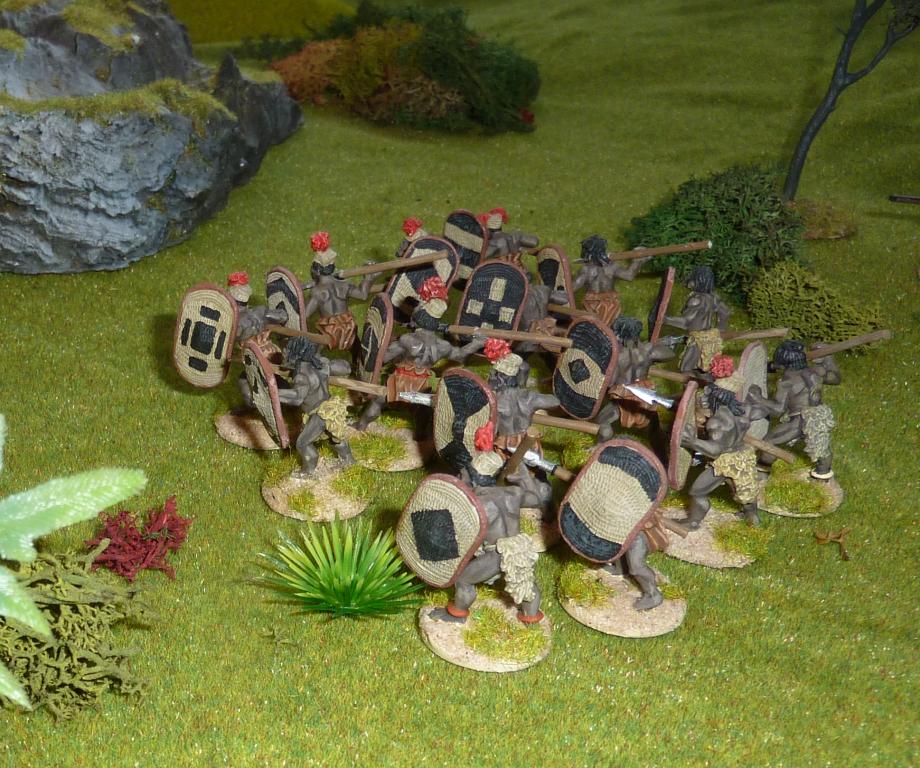
Unit three: Azande spearmen


I chose my army first, using all of my Azande but not using the Congo allies which I use sometimes to boost the forces.  Somewhere I have another couple of dozen Azande to paint which I might do now as the points value of Guy's Belgians was such that he didn't get to field many figures.


My fourth unit: more musketmen


Forces were:

Azande

1 Leader
1 standard bearer
1 unit of 11 agile warriors
1 unit of 15 agile spearmen
1 unit of 16 musketeers
1 unit of 12 musketeers

56 figures in all

4 baggage elements consisting of two musicians and a couple of girlies.


Guy's small force deployed on a hill


Belgians

1 Leader (white man)
1 standard bearer
4 units of six Force Publique soldiers

26 figures in all

4 baggage elements consisting of a mule, two porters and a "man with a bottle of rum", according to Guy (Pirates of the Caribbean has given him a fascination for rum which his teetotal mother finds quite disturbing!). 

Guy was a bit concerned about the relative sizes of our forces; especially as I had a lot more Belgians I could field and he was very tempted by the mountain gun but thought that it cost too many points.

It was a straightforward encounter battle and as Guy hadn't played the rules before and I hadn't played for years we just put our units within the required six inches of the long table edge.  We could have put one unit 18" in as an advance guard or even put one in hidden ambush but decided not to play any add-ons this time.


The Azande advance...


Guy put his force on a hill at one corner of the board and, as he later told me, his plan was to stay there and let me attack.  In a very un-Azande like way I decided to charge at him head on and right from the start suffered casualties caused by his elevated askaris.  They outranged my musketeers by 20" to 10" and they could fire every move whereas my musketmen had to spend a move re-loading after every shot they fired. 


Shooting is basic and brutal in the Darkest Africa rules.  Targets and shooters are dealt with individually and his Belgians hit on a score of five or six; scores being worked out by a D6 throw plus 2 and a few modifiers (such as -1 if at more than half range).  Guy's first volley knocked out enough figures that I had to take a morale test which, fortunately, the Azande passed.  Both the leader and the standard bearer were too far away to help on the morale test.  Indeed the standard bearer got consistently low movement dice (movement is a set amount (2" for Azande plus a D6) and never caught up with the main force so was useless as a morale test saver (which is, basically, their only role).


Belgians take the high ground


Guy then pushed one unit onto a hill and blasted away at the Azande from on high; whittling down my units at an alarming rate.  Because of the dense terrain I could never get my musketmen to get enough guns to bear and they suffered with their ten inch shooting range. 


The Belgians form up...


Seeing how well things were going Guy brought the rest of his Belgians down from the hill and they formed a devastating firing line, routing one unit and annihilating another.  In order to win against a Colonial army like the Belgians you need to close into hand to hand combat with overwhelming numbers.  In the end I did get three figures into melee but by that time they were outnumbered by the Belgians and were all shot on the way in to the attack.


These three Azande did charge but to no avail...


Although I did pretty much clear the hill of  the Belgian advance guard by then it was too late and my forces were totally destroyed.  In the end Guy's army surrounded my baggage elements, the only figures I had left on the table.


The Belgians capture a ready made party: musicians and girls!


So, it was a fun, quick game, over in about two hours, and we will certainly have another one soon.  Next time I am not going to charge European troops head on and I will also go for smaller units.  The figures in the bigger units, especially the musketmen, got in each other's way a lot.  Small units of musketmen and bigger ones of hand to hand troops are what is needed, I think. 


Guy's losses


I was lucky with my morale tests but at one point it looked as if I was going to see an entire 16 man unit bolt.  I will also look at painting up some more Azande so we can field more Belgians.  One thing it had shown me is that I don't need any more Belgians; not without a lot more natives anyway.  I had been planning on buying some more but now realise that my Belgian army is, to all intents and purposes, complete.  Hooray!


My losses!

Sunday, 22 August 2010

Music to paint by: Mountains of the Moon soundtrack by Michael Small


I like to (have to!) paint to music and prefer to have something vaguely appropriate playing in the background. I'm having a bit of an Africa phase at present and so have been struggling to find enough relevant music.


I had a few pieces, the Zulu soundtrack of course (with the addition of the extra pieces from the Silva Screen version-I am nothing if not a completist!) and Out of Africa both by John Barry, but neither are particularly African sounding.


Some of the incidental music from Hatari, by Henri Mancini and some of Laurence Rosenthal's music for one of the Young Indiana Jones episodes was much better.


I also have some genuine Zulu music and other African chants but, rather like bagpipe music, there is only so much of it you can listen to at a time!


I was delighted, therefore, after a long search, to find a copy of the Mountains of the Moon soundtrack on the internet from a UK seller (rather than one of those dodgy bulk sellers from the US you find on Amazon). Mountains of the Moon is the ultimate Darkest Africa film and I am sure Mark Copplestone knows it well!


The film itself is based on William Harrison's superb (although somewhat controversial) novel Burton and Speke (1982) which is, rather surprisingly, currently out of print. The novel is based itself on Sir Richard Burton and John Hanning Speke's accounts of their attempts to discover the source of the Nile. Harrison, (who also wrote the original short story and the subsequent screenplay for the film Rollerball) himself co-wrote the screenplay with director Bob Rafelson, for whom it was a very personal project.

Its not Zanzibar but this is what it must have looked like at the time

I actually didn't see the film until after I had started buying the Foundry figures and reading some of the original accounts of African exploration. I was amazed at how well the film visualised these accounts.

Burton and Speke's prototypical explorers camp. Watch out for Somali tribesmen!

 
For the soundtrack to his film Rafelson turned to a composer he had used before; New York born Michael Small. Small had scored two steamy Rafelson thrillers; The Postman Always Rings Twice (1981) and Black Widow (1987). I remember taking a girlfriend to the former as a first date and it certainly had the desired effect on her; with a lot of the credit going to Small's sensuous music!

Sidi Bombay (with rather better teeth than the original)


Small was born in 1939 the son of an actor who instilled a love for musical theatre in him. Whilst Small learnt the piano and started to write for student reviews he actually studied English at Harvard and didn't study music formally until after university.


Classic Darkest Africa expedition with required baggage elements


After some TV work Small scored his first feature film in 1969 his breakthrough coming with the score for the Jane Fonda film Klute (1971). He then wrote the soundtracks for a number of well-known films including: Comes a Horseman (1978), Marathon Man (1976) and The Stepford Wives (1975). He also provided music to some of the worst films ever resulting in the situation where his scores were very much the best thing in them. In this illustrious category comes Jaws: the Revenge (1987) and Wagons East (1994).

Masai!

 
Smalls score for Mountains of the Mood mixes some memorable sweeping themes, urgent action cues and ethnic music which draws on some recordings made by David Fanshawe. It really is the perfect music to listen to when painting Darkest Africa figures and I have already based up John Hanning Speke and Richard Burton to work on when I get back to the UK.


Its a shame Mark Copplestone never did any Arabs on camels


The film itself is a must see if you haven't already. Filmed in Kenya, rather than the original locations (which are now in Tanzania), if it doesn't make you want to buy loads of Foundry Darkest Africa figures nothing will!


Sunday, 18 July 2010

Congo Bowmen


I am trying to finish some figures that have been sitting around half painted for far too long so here is a group of archers from the Congo who would make good allies or opponents to the Azande.

I'm pretty sure that the Azande themselves didn't use bows (using their kpinga throwing knives instead) and, if they did it would have been early in the Darkest Africa period on as they took to the musket early; using it for an ambush based type of warfare.

Friday, 4 June 2010

Omani Baluchis


I just sat down last week to paint a few Foundry Baluchis when, blow me, Giles put some lovely ones up on his blog.  This was rather like the lunch I went to a couple of summers ago where my wife was very proud of her expensive new dress only to find that someone else there had an almost identical one...and that person was Liz Hurley! Or, maybe, its just that great minds think alike..!


My figures are from the Foundry "Baluchis in Arabian dress" packs. What makes them distinctly Arabian is that they are all carrying the distinctive "J" shaped Khanjar dagger; meaning that they originate from Oman.


The Baluch (technically, Baluchi is the name of their language) are a people whose origin is rather mysterious. They may have been descended from Syrian Arabs or, more likely, be Persian in origin; coming from the Caspian. Wherever they originally came from, they settled in that part of central Asia where modern day Iran, Afghanistan and Pakistan meet. In the seventeenth, eighteenth and nineteenth centuries many Baluch crossed the Persian Gulf and settled in Oman, Bahrain and an insignificant little fishing village called Dubai.


I gave this one a waistcoat using traditional Baluch colours based on this picture of a Baluch woman


The first Baluchs in Africa were mercenaries hired by Saif bin Sultan, the imam of Oman, who was leading a campaign down the East African coast. Driving the Portuguse out of their stronghold of Fort Jesus in Mombasa in 1698 the Omanis, with their Baluch soldiers, soon cleared them from Zanzibar and from the coastal regions of what is now Mozambique as well. Zanzibar was a prime conquest housing, as it did, the main east African slave market. In fact it became so important under Omani rule that the ruler of Oman, Sa'id ibn Sultan, moved there from Muscat in 1837, made it his main residence and commenced a major building programme. By this time many of the Baluchi soldiers and their descendents, who had been followed by other Baluchs from their homeland, had spread across East Africa from their original garrisons at Mombasa, Dar-es-Salaam, Zanzibar and Pemba. They kept their distinctive identity, however, but by the 1850s, the period which these figures represent, "Baluchis" could have been born in Oman, Africa, Iran or Pakistan; hence the variety of dress in the Foundry packs.


The Omani Baluchs tended to favour plain, saffron dyed robes. Apart from the Khanjar dagger they were armed with silver damascened, long-barrelled (because of their weak gunpowder) matchlock muskets, and long straight swords (non-Arabian Baluchs favoured a curved sabre).


Addax antelope


The Arab Baluchs also carried a small 30cm diameter buckler which was often white, either through bleaching, or because it was made from the hide of the addax antelope. One of these figures is depicted with the four boss Persian type of buckler more often seen on Baluchs from the eastern side of the Persian Gulf.

By the early 1880s the Baluchs, as official troops of the Sultan of Zanzibar, had been dismissed and replaced with troops dressed in a more conventional Egyptian style, so these figures are for the pre-Colonial period. Natural opponents would be Masai, Tuta, Ngoni and some of the Congo tribes including the Azande.


My Khanjar dagger; probably the best present I have been given on an overseas trip (apart from the Chinese girl the Foreign relations ministry "presented" me with in Beijing)


The distinctive Khanjar dagger (actually that is tautologous; "khanjar" is simply Arabic for "dagger") is still seen regularly in Oman and every adult Omani male has one; usually kept in a red, velvet box. I have been to Oman several times and was lucky enough to be presented with one by an Omani minister. The silver filigree is distinctive and the hilts are usually sandalwood or, on expensive examples, ivory or rhino horn.


These figures were, as ever with Mark Copplestone sculpted ones, a delight to paint. Like Giles I had to think about skin tone but Baluchs are quite pale so I mixed a sort of sun-tanned Caucasian colour. African-born Baluchs were, by this time, quite often the product of mixed marriages and so a wider range of skin tones can be used for them.


Oman is a lovely place, with attractive towns (deliberately lacking in high rise buildings), friendly people and attractive, surprisingly green, mountain valleys filled with pomegranate trees. I thoroughly recommend The Chedi Hotel in Muscat, if you are ever there. I don't usually like modern minimalist hotels but this is very well done, with villas scattered around cleverly sited pools of water, a nice beach and wonderful restaurants.

Thursday, 7 January 2010

First Masai


I have finished my first Foundry Masai warrior and he came out very well; largely because the black, red and white shields are so striking. Painting the shield was really very easy and that had been the bit I was putting off. I have undercoated some more now and will start them tonight.


This particular figure would make a good scout for a World War 1 East Africa British army. I hesitated about the loincloth colour but went for a later trade goods red rather than the original animal hide effect. Even though earlier Masai fighting Baluchis and Arabs should probably be wearing the animal hide, the red looks so good that I am going to stick with that I think. It's an easy choice with the next lot anyway as they don't have loincloths!


Whilst researching shields I came across this splendid painting by famous fantasy artist Frank Frazetta which I hadn't seen before. It certainly demonstrates the problem with oversized cast spears! I was reading recently in one of the magazines a suggestion that someone should start producing detailed in scale weapons in hard plastic. This would be an excellent idea: the Wargames Factory plastic weapons and shileds are certainly prefarable to the Empress Miniatures metal ones. The Masai's spears are unlikely to be a top choice for someone having a go at this, however!

Masai by Frank Frazetta (1980s reworking of 1961 original)

Thursday, 10 September 2009

Coming soon...The Masai


I've managed to resist these, somehow, for a decade (yes the Foundry Darkest Africa range is that old and more) but the recent 20% off Bank Holiday deal saw me give in at last. I plan to use them as opponents to my Arabs and Baluchis, early Colonial DOAG Germans and in WW1 skirmishes.

Foundry are a funny old company. I'm not one of those people who habitually knock them as I like (most of) their figures and find their mail order service exceptionally good. It's almost instant gratification with Foundry. You put your order in one day and quite often they arrive the next. I don't even have a problem with price as I'm very lucky and don't really have to budget. However, some of the things they have done baffle me. In order to prevent price rises a few years ago they took most of their packs from eight to six figures a pack. This meant that some figures effectively disappeared or turned up in odds and ends packs. Secondly, and much more annoyingly, they stopped including weapons in some packs. I recently bought some of their (excellent) gladiators but the retiarii didn't have tridents included! I was lucky in that I found some on eBay, but how annoying! I have had a similar problem with the Masai. the Masai had quite distinctive looking spears which Foundry included in their packs. No longer! The usual note that you have to provide your own wire spears is apparent. So when my packs arrived; no spears. But blow me down you still buy the individual cast spears as seperate packs on their website (they work out at 24p each). This really is a bit much. If you are making the spears and the figures need them you really should include them. My annoyance was tempered somewhat by the fact that all the supposedly six figure packs had seven figures in them. Even so...

As usual I have started one figure to see how it goes and once my Sudan game is over I shall be working on Masai and Zulus at the same time for a bit.

Wednesday, 26 August 2009

Death in the Dark Continent by Chris Peers


I just picked up the new Chris Peers African rules. I have had his In the Heart of Africa rules for some time and even, shock, played two or three games with them! However, as he says in his introduction to the new set they were, firstly: designed to go with the Mark Copplestone Foundry figures and so included a restricted set of armies and secondly, were really a large scale skirmish set.

The rules cover the period 1870-1899 and end at the latter date quite deliberately as he believes that the Second Boer War was a different sort of campaign. What it does mean is that these rules will work for the Zulu War and the Sudan as well as other colonial conflicts. Some new lists are included over and above those in the original rules: such as Mahdists and much better coverage of Colonial armies in different theatres.

My only slight concern was the need to have multiple based troops but given he suggests a 60x30mm base for 3 troops and mine are based on 20x20mm then making small trays will deal with this quite easily (if time consumingly!) It will be interesting to try them out and compare them with The Sword in the Flame which also uses larger units, rather than being a skirmish game; although in the latter figures are individually based which can make moving large numbers very time consuming.

The rules are available from North Star (although I bought mine in Orc's Nest in London, which is only about 400 yards from my office in trendy North Soho!). North Star also have some extra lists available for free download.

Time to paint some more Ruga Ruga, I think!