Wargaming the Exploration and Colonisation of Tropical Africa by European powers from 1850 until 1918.


Tuesday, 17 April 2012

Zambezi Campaign 21: Amelie Croissant in travelling dress


This is another figure that I have had sat on the workbench for ages.  I had painted her (not very well) years ago but decided to freshen her up to depict her appearance on arrival at the Zambezi headquarters of the British force; ready to show her press credentials to Commissioner Sanders.


I am moving along with my second and final Arab cannon and the second unit of wangwana freedmen askaris as well.  I hope to have both these units finished by the end of April which will give me enough figures for an opening skirmish in the campaign.

Tuesday, 27 March 2012

Zambezi Campaign 20: Naval Brigade Gun and crew


So here is the last fighting unit of the British force: the Naval Brigade Gun and Crew.  It's taken me some time to work out how to handle this and it is something of a compromise solution but I must be getting old as I don't care about total historical accuracy so much, now.  After all, this campaign will have some definitely non-historical elements!
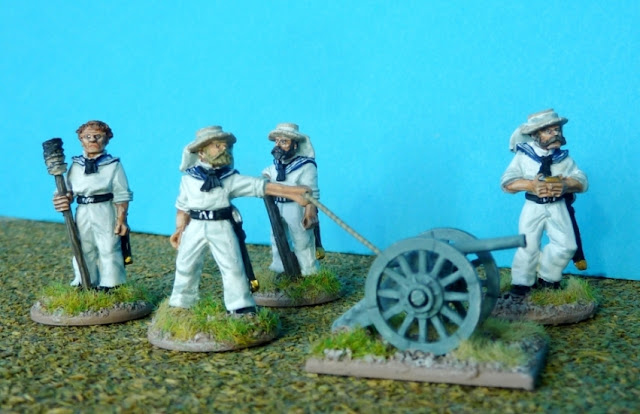


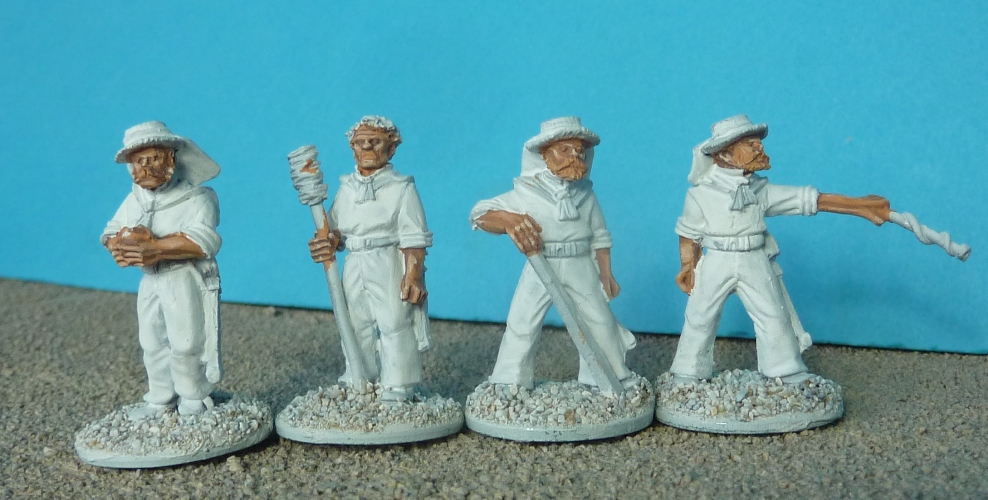
The crew are Mutineer Miniatures Indian Mutiny figures so they are from around forty years too early.  The basic uniform didn't change that much, other than the fact that the later troops would have worn gaiters but as the trousers are the same bell-bottoms maybe they just left their gaiters on board!  These chaps also have a collar, rather than the round collared shirt, but you can barely see that.  The main thing for me was that the size and bulk of the figures are very close to the Copplestone Naval Brigade infantry.  Foundry, for example, had a Zulu Wars period gun crew but they would have been very small in comparison, so I am happier with these.


The gun is also a compromise as it is a French 80mm De Bange (yes, really!) mountain gun, first produced in 1885, so fine for the period.   Our argument here is that either the Royal Navy won it in a game of cards from sailors from a visiting French warship or captured it off a group of slavers.  Whatever, this Askari Miniatures model comes in a pack of two, enabling me to set one up on a mule train, as they were carried in real life.


Colonel Charles Ragon de Bange


The De Bange 80mm mountain gun was one of a series of French artillery pieces designed by Charles Ragon de Bange (1833-1914).  De Bange's claim to fame is that he invented the first effective breech obturator which provided an absolute seal for artillery breech mechanisms for the first time: a system still in use today. The only disadvantage with his guns, as with previous artillery, was that the recoil meant that they had to be re-aimed after every shot, something that wasn't solved until the French 75 in 1898.  Still, this breach loading piece of ordnance, which could fire six kilo explosive shells or shrapnel, would be very effective against slaver compounds.  Firing shells it had a maximum range of 4,300  metres.  It was manufactured by the Societé anonyme des anciens établissements Cail, originally set up by the French engineeJean-François Cail in 1836.


All the examples I have seen pictures of have an all-over paint finish so I have done mine the same way using a British artillery grey.

Tuesday, 28 February 2012

Zambezi Campaign 19: Artillery problems solved (or not)!


Naval Brigade Gun crew under way


I only need to paint a Naval Brigade gun and crew to finish my British force but have been held up due to problems in how to do this.  What I need is a Royal Navy gun crew and gun for the paddle boat.  The only suitable Foundry figures came from their old Zulu Wars range and were rather small compared with the Copplestone Darkest Africa ones. Then I saw the new Mutineer Miniatures Naval Gun crew and they seemed just the right size.  Although they come from 1856 not the 1890's there doesn't seem to be much difference in the uniform other than the shirt collar; the later uniform had a collarless shirt.  I did think about trying to carve this off then decided that no-one will notice by the time they are on deck and around the gun.  Anyway maybe they find a shirt with a collar wards off bugs better!

I was then wondering about a gun for them.  An old style naval smoothbore cannon on small wheels wouldn't be right as I wanted to be able to take it off the boat and up country.  Something like the mountain gun fielded by the Arabs and my Force Publique force would be just the job.  It would mean buying a gun with  a redundant crew however.

Meanwhile, I also needed a second gun for my Arab force.  The first one I bought from Foundry was missing the gun barrel and although they replaced the pack very quickly this left me with a crew but no cannon.  I didn't want to have to buy another pack just for the gun barrel.

I thought that both these problems had been solved in one go by looking through the catalogue of a firm I hadn't really looked at before, Askari Miniatures.  They have a pack of two French mountain guns which would give one to the British and one to the Arabs.  However they also have a nice pack of four mules designed to carry one of the guns.  I couldn't resist this so have ordered the guns and the mules although this now leaves the Arabs without their second gun.  Maybe I can make a gun barrel!  I probably need another mule now but may have one somewhere.

I don't know how long the models will take to arrive from the US but at the rate I'm painting they will probably be here before I finish the crew, although I did get started on them today.

Saturday, 3 December 2011

Zambezi Campaign 18: Veronique Croissant's gun


Ogilvie VC was postulating, in a comment on my last post, on what sort of gun Veronique Croissant was carrying and suggested a Purdey.  In fact, she is carrying a Joseph Lang 6-bore percussion elephant gun.


Hampshire-born Lang was originally a gun seller before moving into gun manufacture.  He was a contemporary of James Purdey, whose guns he sold, and married one of Purdey's daughters.  An excellent competition shot and innovator he exhibited his guns at the Great Exhibition in Crystal Palace in 1851 and then in 1855 at the Paris Exposition Universelle.  Veronique's father, Victor, was one of the more than 5 million people who attended the exhibition in Paris and it was here that he first saw Lang's guns.  He bought this weapon on a visit to Lang's Cockspur Street premises on a trip to London in 1857 ready for the South African safari he was planning the following year.


Ever since she was  a little girl Veronique had a passion for rowing on the River Sâone near the family home in Lyon.  As a result she built up very unladylike upper body strength so that she was the only one of the Croissant sisters able to use the gun.  Her father, therefore, had no problem with lending it to her when she declared that she was travelling to Africa with her older sister, the intrepid reporter, Amelie.

Sunday, 27 November 2011

Zambezi Campaign 17: three more characters


I have very little time to paint at present and the light isn't very good anyway but I have managed to finish three more characters for the Zambezi capaign.  First up we have Commissioner Sanders Wallace.  Responsible for keeping the peace on the whole Upper Zambezi he has no compunction about calling in a heavy military response if the natives start getting uppity.  He is getting concerned about  Arab slavers upriver; especially as they appear to be in posession of some artillery which is having a very de-stabilising effect on the region.  He doesn't figure in the Gary Chalk scenarios but I liked the figure and am just reading Edgar Wallace's Sanders of the River which is a masterclass in conveying character and plot in the most economical and spare way possible.


Sean Sweeney is one of Trader Jones' "clerks" and is very much the hired muscle of the trading post.  When he's not drunk on Bushmills Whiskey he is a crack shot.  He features in the Trading Post scenario.


Finally, we have the French reporter Amelie Croissant's younger sister Veronique who has always been at the centre of whatever trouble is happening.  Amelie has told her to stay behind at the military post but hasn't counted upon her skill as a stowaway.

Thursday, 1 September 2011

Zambezi Campaign 16: Amelie Croissant


This young lady isn't in the Gary Chalk scenarios but I have had her on the workbench for some time so feel I can put her in somewhere.

I was looking for an annoying lady reporter to join the steamboat transported reinforcements but decided what could be more annoying than a lady reporter who is French?  Hence she has become Amelie rather than Amelia.  Sent by her publication in France (probably something like La Vie Parisienne) in the hope of seeing the British make a mess of things and also follow up rumours of a tribe of warrior women led by a white woman.  She will, of course, be a total liablity!

Incidentally, this figure demonstrates how Mr Copplestone is one of the very few who can sculpt attractive female faces.  Lots of sculptors can do bodies but very few can do pretty faces!

Sunday, 17 July 2011

Zambezi Campaign 15: Arab Cannon


Well, at last I have finished another unit for the Arab force.  For the scenarios I am using I need two cannon like this.  The first one I bought from Foundry didn't have a barrel but when I reported this to them they sent me another pack by return.  So I have two crews but only one cannon.  I think I will use the cannon from my Force Publique army to give a slightly different field piece.  The crews are identical but I will paint the other one up differently.


Monday, 16 May 2011

Zambezi Campaign 14: First unit of Wangwana


Having now finished the British force (except for the gunboat) I have moved on to the Arabs, who are the most numerically large of the various forces needed.  The first unit I have finished is of 14 Wangwana: the freed-men of Zanzibar. 


These Swahili of the East coast of Africa supplied most of the troops for the Arabs from Zanzibar and, indeed, those who had settled further into the interior, like our theoretical slavers in these scenarios.  They also worked for European explorers and this picture of Speke's "faithfulls" gives a good idea of their apperance.


In most pictures I have seen they are shown as wearing white, although they did wear blue and red tradecloth and even some striped material in the later period.  There seems to be a suggestion that they may have saved these brightly coloured clothes for best so, on the whole, I am going to keep them dressed in white.


I need to paint three units of fourteen of these and have already got the second unit based and undercoated and the third unit based.  I will alternate painting them with other figures I have part-painted on the workbench, so I think I will take a break from these for a bit and finish some Zulus that have been sitting around for far too long.


Leading the unit is an Arab from Zanzibar.  In fact many of the "Arabs" at this time had interbred with Africans and, indeed, it was said that they were successful at settling in the interior as they had inherited some resistance to malaria from their African forbears.


These will be useful figures I can use in explorers' forces as well.  I thought they might be a bit boring to paint but found the simple colour scheme quite relaxing!


Tuesday, 3 May 2011

Zambezi Campaign 13: British force completed and two more characters


Well, it's taken four months but I have now fininished my British force for the Zambezi campaign.  A unit of Sikhs, two units of regular askaris, a unit of irregular askaris, two units of Naval brigade plus command and baggage.   61 figures altogether but I painted some extras too so altogether it's 74 figures.


I have also painted two more characters, for the McKenzie's trading post scenario.  This requires a trader, McKenzie, and three clerks. My trader is called Jones, after the character in the underrated and quite brilliant animated children's TV series Charlie Chalk.  Here he is (right) with one of his clerks Portuguese Paulo (left).  I need to find another clerk for him, who will probably be a native and for the fourth character I think I will give him a wife.  Hopefully I will get these two done in the next week.


Trader Jones is sick of his bossy wife and wishes he hadn't persuaded her to go up the Zambezi with him as he quite likes the look of the native girls who would be very happy to look after him in exchange for beads, cloth and whisky.  He wishes he had followed the example of his brother, Vic, who had the sense to travel to the South Seas instead to set up his trading post.

In fact the British force is not quite complete as I have to finish my gunboat, which means finding a suitable artillery piece and naval crew for it.  Mutineer Miniatures have just released a naval gun crew which, although from forty years earlier, will probably do.  Their figures will certainly look better with the Copplestone and Foundry ones than the rather lumpy Zulu War naval crew from Foundry.

I have now also started work on my first Arab unit and hope to have these finished by the end of this weekend.

Tuesday, 19 April 2011

Zambezi Campagn 12: Major Hadden Bowen


Major Bowen, commander of the land expeditionary force


I had already painted two figures for the British officers but decided that one of them looked to old to go gallivanting about up river so he has been promoted to Colonel and will remain at the base further down the Zambezi.  I may put him, Colonel Perceval Hedley, on the paddle boat with the naval reinforcements.


Colonel Hedley


So I needed a new commander for the force, Major Hadden  Bowen.  I've decided that he is a tough, no nonsense man who learnt his trade in Afghanistan and would be likely, unlike his stuffy Lieutenant, William Baker-House, to dress down in the field.


He also wears one of the wider brimmed Wolseley helmets; named after Sir Garnet Wolsely who sported one in the Sudan War of the 1880s. Also called the Solar Topi, this helmet was not yet official issue for officers (it would be by the Boer War) but was very popular with British officers serving in this part of Africa in the 1890s. They would probably have bought theirs at Cearn & Company, Government Road, Nairobi.